Where is the disability community?
I talk and write a lot about “the disability community.” Recently, talking to people who are new to becoming or calling themselves disabled has made me think about what, exactly, I mean by those three words.
Often, they can be used as an umbrella term, a way to describe all disabled people, or all disabled people who speak up for our rights. But those words mean something different to me.
When I started to claim my disability, I knew I wanted to be part of this community I had been hearing so much about. But how? You don’t get a letter through the post or in your inbox that confirms your spot in the disability community. “Community” won’t magically appear. Community is a verb, an action, a choice.
Building my community
You have to show up, so that’s what I did. Online and in person, however and wherever I could. And other disabled people welcomed me warmly and without reservation. I joined Facebook groups and filled my feeds with other disabled people. I read #OwnVoices* books and listened to podcasts about crip culture – and reclaimed the word “crip.”
I was anxious each time I sent an email, commented on a post or attended an event. That anxiety will probably never go away. It’s part of me. But I did the hard things, and it paid off.
People followed me back, replied to my comments, talked to me at events. Over time, it added up, and now I’m so lucky to be part of a beautiful network of disabled people.
There are layers to my community, each of them precious, each of them needed. There’s my disabled friends. The ones I can text or voice note or video call to vent or celebrate or cry about all things (disability related or not). Some of these friendships developed in person. Many of them will only ever exist online. Some of these friendships are close and some are distant.
Then there’s the people with whom community looks like shares and follows and reactions. Like launching campaigns and sharing their stories or reading and responding to mine. We don’t have to exist in the same country or life stage or social class to know the exhaustion of ableism, the joy of disability pride.
The bonds of shared understanding in being disabled
Perhaps the most uplifting part of all this for me is the way that I am connected to people I will likely never meet or know.
Community is sharing the same mutual aid call out that has been filling my feed as other disabled people in so-called Australia post or share it too. It’s going to the donations page and seeing the names of so many more disabled people I know, witnessing our care, our determination to support one another when the system won’t.
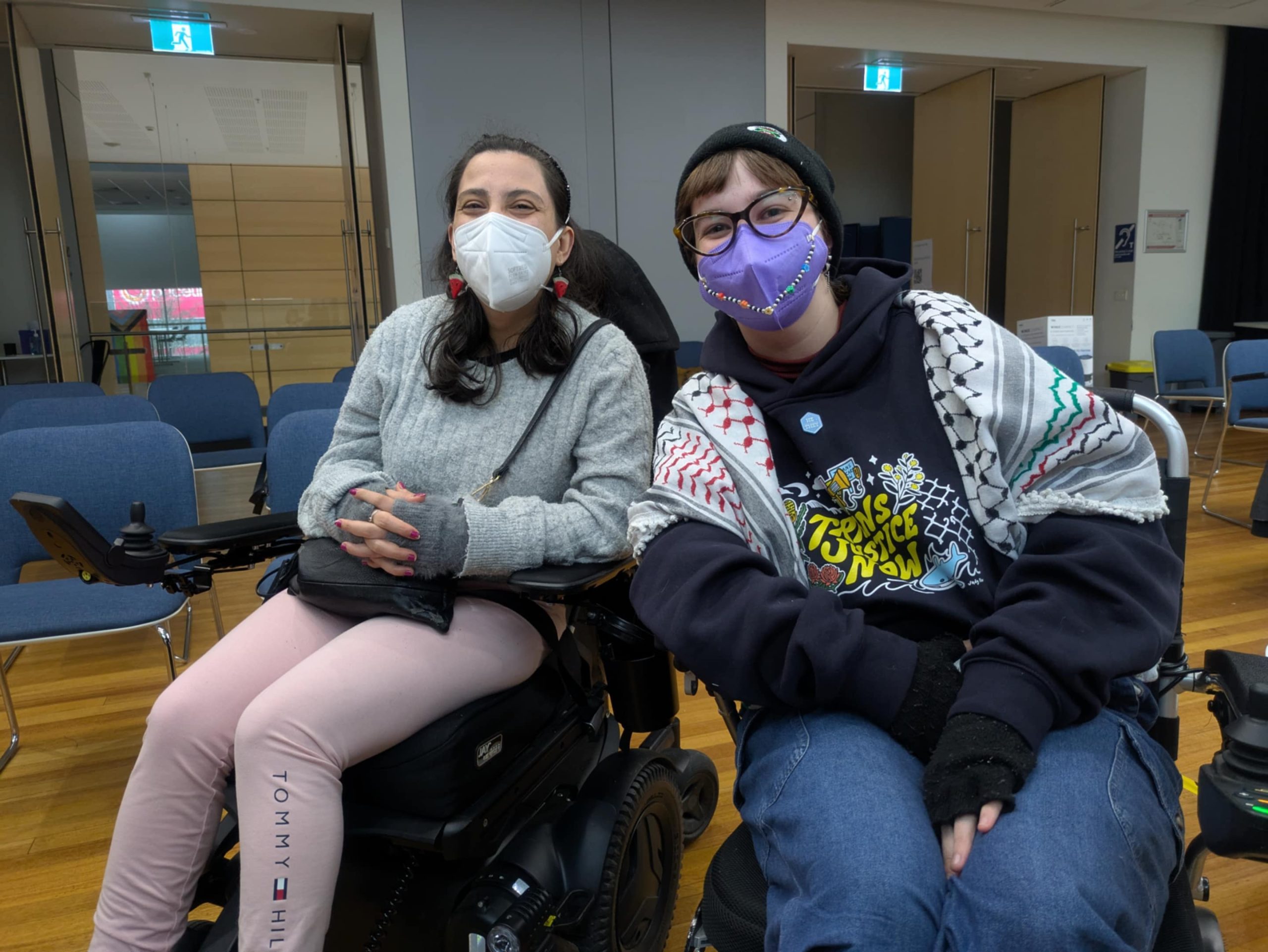
The disability community is made of wisdom hard-gained and freely given: messaging a fellow writer I’ve met once for advice about gloves for wheelchair use.
It’s a knowing eye-roll across a room or a private message on Zoom when a nondisabled person says something predictably yuck. The nod of understanding when I pass another mobility aid user on the street.
It’s about receiving support and offering it in return.
Community is give and take
Far more important than what I get from others is what I give (or try to give). Lending my wheelchair to a friend when theirs is broken, speaking up about access needs that aren’t my own, so others don’t have to. Checking in on my disabled friends when there’s been yet another funding cut, another legal decision made about us, without us. Recommending other disabled creatives for work whenever I can.
Those things feel small compared to the comfort and support the rest of the community gives me, but it’s the best I can do. And if I’ve learnt anything as I’ve immersed myself in the world of disability, it’s that my best is enough.
Community is for all of us
If you’re a disabled person seeking connection and thinking you’ll never find it, know this, from someone who spent most of her life thinking the same: you will. And it will be wonderful.
*#OwnVoices is when a writer has lived experience of what they are writing about.
Laura Pettenuzzo is a disabled writer, speaker and accessible communication expert. Her memoir, criticism and opinion pieces have appeared in places such as Griffith Review, ABC, Meanjin and The Age. She is the Access and Inclusion Officer for the Disability Dialogue. In 2025, she started an Easy Read and accessibility business called All for Access. You can usually find her reading with a cup of tea beside her and her cat on her lap.
Want to write for the Belong blog? Email Zoe@drc.org.au.
Looking for a community that understands? Why not join Belong, our free disability-led , all-disabled community. We are radically inclusive, and do both in-person and online events and provide support to those in the disability community. Find your community today!